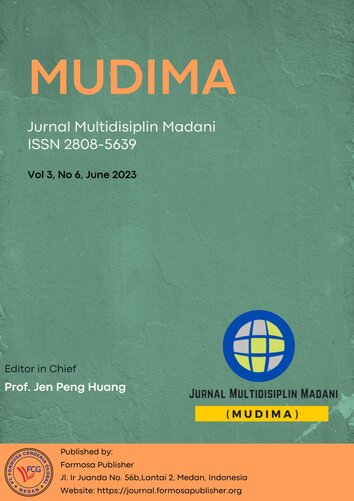
Effects of Teachers’ Interpersonal Conflicts on Their Motivation at Sec-ondary Level in Gilgit
DOI:
https://doi.org/10.55927/mudima.v3i6.3456Keywords:
K-12, Behavior, Motivation Behavior, Interpersonal ConflictAbstract
The study was aimed to explore the teachers’ interpersonal conflicts and their motivation level. It also intended to determine the relationship and effects of teachers’ interpersonal conflicts on their motivation. The study was descriptive type of research and carried out in a quantitative manner. Population of the study encompasses all the teachers of the public sector lower secondary schools in Gilgit. There were 150 teachers appointed in 12 secondary schools. Random sampling technique was used and 100 teachers were randomly selected from the population for the study. A comprehensive questionnaire was developed for the teachers to explore the teachers’ interpersonal conflicts, motivation and their relationship. The questionnaire comprised two scales, one was conflict assessment scale and the second was motivation assessment scale. The data was collected by the personal visit of researcher and finally analyzed and tabulated by using SPSS 16th edition. Statistical operations like Cronbach’s Alpha Reliability, Correlation, and Regression analysis were used to analyze the data and find the results of intended objectives. The interpreted data shows that the majority of respondents which is 64% of total sample population were found in an average level. The collected teachers’ opinions explored that there are interpersonal conflicts which they are facing with their fellow workers, supervisors, students, and parents of teachers. The second finding of study was the motivation of teachers. The opinion given on the questionnaire by the teachers show that the majority of respondents have high motivation level. The last and main finding of the study explores the effects of teachers’ interpersonal conflicts on the motivation of teachers. The statistical measurements determine that there is a relationship among the interpersonal conflict and motivation of teachers and these conflicts affect their motivation level. The effects of conflicts on the motivation measured through regression were 8.1%. While this effect was significant at 0.01 level of significance (β= -0.26, t= -2.93). So, to decimate this effect it’s quite necessary for the organizations and institutions to take precautionary steps prior to the occurrence of conflicts and overcome the communication gaps. Awareness sessions and seminars may have positive indicators for the prevention of conflicts
References
Fujiwara, k. Tsukishma, E. Tsutsumi, A. kawakami, N. &Kishi, R. (2003). Interpersonal Con-flicts, Social Suport, and Burnout among Home Care Workers in Japan. Journal of Occupational Health. (2003); 45: 313-320.
Hinnekens, C., Loeys, T., De Schryver, M., &Verhofstadt, L. L. (2018). The managea-bility of empathic (in) accuracy dur-ingcouples’ conflict: Relationship-protection or self protection? Motivation and Emotion, 42(3), 403–418. https://doi.org/10.1007/s11031-018-9689-z
Kearney, P. (2011). College teacher misbehaviors: what students don’t like about what teach-erssay and do. 39(4), 325-340.
Kurtz, Lloyd. (2018)- A Review of Studies on So-cially Responsible Investing." The Invest-ment Research Guide to Socially Respon-sible Investing, The Colloquium on So-cially Responsible Investing, 1998.
Kanter. R. (2018), Commitment and Social Organ-ization: A Study of Commitment Mecha-nisms in Utopian Communities, American Sociological Association, p. 499
Lavoie. R, (2007), The Motivation Break-through: 6 Secrets to Turning On the Tuned-Out Child, Simon and Schuster Publisher, p-400.
Lawler, E.E. (1973).Motivation in work organ-izations. Montery, California: Brooks/Cole Publishing.
Michal J.Jucius. (2015). Personnel manage-ment. R. D. Irwin publishers. p 253,
Oxford Learner Dictionary. (2023). Definition of Conflict, Retrieved on, January 2023, https://www.oxfordlearnersdictionaries.com/definition/english/conflict_1
Poenaru, R., & Sava, F. A. (2018). Teacher abuse in schools. Ethical, psychologi-cal andeducational aspects. Bucharest: EdituraDanubius.
Rahim, M.A. (2002) “Toward a theory of man-aging organizational conflict” The In-ternational Journal of Conflict Man-agement. 13 (3) 206-235.
Robin, P.S & Judge, A.T, (2012), Organiza-tional Behaviour, Prentice Hall; 15 edition (January 16, 2012).
Robinson J, Roy WJ, Clifford RA. (2014), Conflict Management in Community Groups, University of Illinois at Ur-bana-Champaign, North-Central Re-gional ExtensionPublication No. 36-45.
Rutherford, D. G. (1990). Hotel Management and Operations. New York, NY: Van NostrandReinhold.
Saad, D. D. M. Z. b. S., 2018. Impact of Em-ployee Motivation on Work Perfor-mance. International Journal of Scien-tific and Research Publications, March, 8(3), pp. 295-307.
Skinner, B. F. (2017). Revolutiastiintificaa-invatamantului. The technology of teaching: EDP work published 1968.
Stipek, D. (2022). Motivation to Learn: Inte-grating Theory and Practice. Bos-ton,Massachusetts: Allyn and Bacon. (Original work published 1988)
Tyler, K., & Boelter, C., (2008). Linking Black Middle School Students' Perceptions of Teachers' Expectations to Academ-ic Engagement and Efficacy. Negro EducationalReview, Spring 2008.
Walker, W.E. (2016), Changing Organization-al Culture, University of Tennessee Press,Knoxville, TN
Wall, J., &Callester, R. (2015). Conflicts and its management. Journal Of Manage-ment, 3(2).http://dx.doi.org/10.1177/014920639502100306
West,R. (2014). Teacher-Student Communica-tion: A descriptive typology of stu-dents interpersonal experiences with teachers. Communication Reports, 7(2), 109-119.
Whitaker, Todd. (2004). What Great Principals Do Differently. Larchmont, NY: Eye On Education, Inc.
Wiseman, D. G., PhD, & Hunt, G. H., PhD. (2021). Best Practice in Motivation andmanagement in the classroom. Springfield, Illinois. Charles C. Thomas PublisherLtd.
Downloads
Published
How to Cite
Issue
Section
License
Copyright (c) 2023 Anwar Ul Haq, Syed Ghazanfer Abbas, Usama Bashir

This work is licensed under a Creative Commons Attribution 4.0 International License.