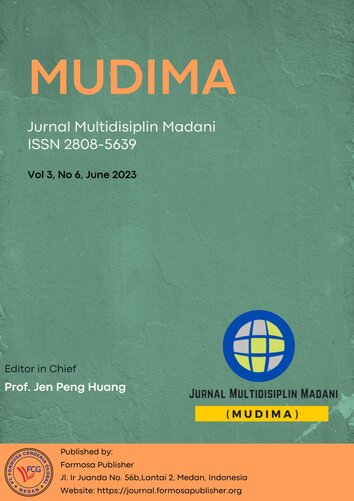
Business Feasibility Analysis of Processed Chicken Feet Products "Dakbal Bali"
DOI:
https://doi.org/10.55927/mudima.v3i6.4136Keywords:
Chicken Feet, Processed Chicken Feet, Business AnalysisAbstract
Chicken feet are a by-product waste from chicken slaughterhouses with very limited utilization. Therefore, a solution is needed in overcoming chicken feet waste into a product with economic value. The utilization of chicken feet can be processed into soup, chicken noodles and chips. Protein content in chicken feet is used as gelatin in addition, chicken feet bones is also processed into flour which contains nutrients, especially calcium. Chicken is processed into products in entrepreneurial activities by one of the students of the Food Science and Technology study program at Warmadewa University. The name of this processed claw product is "Spicy and Chevy Boneless Chewy". The spicy and chewy boneless claw processed product has a name, namely "DAKBAL BALI". The advantages of this product are that consumers are more practical, not messy in consuming feet and the time needed is also shorter and more efficient. The target of selling processed food products per week is 25 packs. The selling time for spicy and chewy boneless feet products is Monday-Sunday, which means that in a month sell 100 packets of spicy and chewy boneless feet (20 kg), spicy and chewy boneless feet. The Break Even Point of this product is 88 packs with a total cost of 1,311,609
References
Almatsier, S. (2005). Prinsip dasar ilmu gizi. Edisi ke-1. Gramedia Pustaka Utama.
Almatsier, Sunita. (2009). Prinsip Dasar Ilmu Gizi. PT Gramedia Pustaka Utama.
Ardi, L. (2019). Manfaat Omega-3 Parenteral di Dunia Medis. Cermin Dunia Kedokteran, 46(10), 12–15. http://103.13.36.125/index.php/CDK/article/view/429
Blaner, W. S. (2020). Vitamin A and provitamin A carotenoids. Present Knowledge in Nutrition, 1, 73–91. https://doi.org/10.1016/b978-0-323-66162-1.00005-6
De Maria, G. (2012). Omega 3. Agro Food Industry Hi-Tech, 17(1), 29–31.
Douglas Wilson, R., Audibert, F., Brock, J. A., Carroll, J., Cartier, L., Gagnon, A., Johnson, J. A., Langlois, S., Murphy-Kaulbeck, L., Okun, N., Pastuck, M., Deb-Rinker, P., Dodds, L., Leon, J. A., Lowell, H., Luo, W., MacFarlane, A., McMillan, R., Moore, A., … Van den Hof, M. (2015). Pre-conception Folic Acid and Multivitamin Supplementation for the Primary and Secondary Prevention of Neural Tube Defects and Other Folic Acid-Sensitive Congenital Anomalies. Journal of Obstetrics and Gynaecology Canada, 37(6), 534–549. https://doi.org/10.1016/S1701-2163(15)30230-9
Ilham, M., Akbar, A., Febryanna, C., & Sulistyono, A. (2018). Peran Asam Folat Dalam Kehamilan Oleh : Margaretha Claudhya Febryanna , dr . M . Ilham Aldika Akbar , dr ., SpOG ( K ) RSUD DR . SUTOMO SURABAYA. August.
Liu, D. C., Lin, Y. K., & Chen, M. T. 2001. (2001). Optimum Condition Chicken Feet Acid Extraction (p. 7). https://www.animbiosci.org/upload/pdf/14-246.pdf
Mhd Sarbon, N., Badii, F., & Howell, N. K. (2013). Preparation and characterisation of chicken skin gelatin as an alternative to mammalian gelatin. Food Hydrocolloids, 30(1), 143–151. https://doi.org/10.1016/j.foodhyd.2012.05.009
Miwada, I. S., & Simpen, I. N. (2007). Optimalisasi Potensi Ceker Ayam (Shank) Hasil Limbah Rpa Melalui Metode Ekstraksi Termodifikasi Untuk Menghasilkan Gelatin. Majalah Ilmiah Peternakan, 10(1), 164–168.
Rahayu, S., Susanto, E., & Eniswatin. (2018). Pengaruh Substitusi Ceker Ayam Terhadap Kualitas Kimia Nugget Ayam. Jurnal Ternak, 09(02), 12–16.
Rosmiati H, & Wardhini, B. (2017). Vitamin A. Dalam Farmakologi dan terapi.
Shaffer, S. G., Kilbride, H. W., Hayen, L. K., Meade, V. M., & Warady, B. A. (1992). Hyperkalemia in very low birth weight infants. The Journal of Pediatrics, 121(2), 275–279. https://doi.org/10.1016/S0022-3476(05)81203-X
Surette, M. E. (2008). The Science Behind Dietary Omega-3 Fatty Acids. 178(1), 1486–1490.
Susanto, D. E. (2019). Peptida Bioaktif Sebagai Antioksidan Eksplorasi Pada Ceker Ayam (D. Novidiantoko (ed.)). CV Budi Utama.
Whelan, J., & Rust, C. (2006). Innovative dietary sources of n-3 fatty acids. Annual Review of Nutrition, 26, 75–103. https://doi.org/10.1146/annurev.nutr.25.050304.092605
Yusran. (2019). Kajian Produk Tepung Pada Berbagai Jenis Ceker Ayam Dengan Panci Bertekanan. 561(3), S2–S3.
Downloads
Published
How to Cite
Issue
Section
License
Copyright (c) 2023 Putu Diah Wahyuni, Ni Made Ayu Suardani Singapurwa

This work is licensed under a Creative Commons Attribution 4.0 International License.